

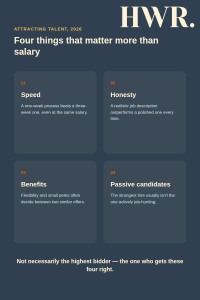
When good candidates are scarce, the instinct is often to offer more money. It’s rarely the fastest or most effective lever available — and it’s usually not the one that makes the difference.
Speed wins more often than salary
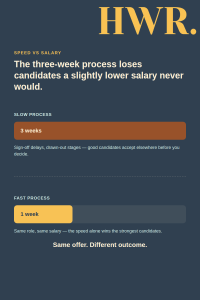
A strong candidate in a tight market isn’t sitting still. A process that takes three weeks to get from application to offer will lose people to employers who can turn it around in one — even when the role and salary are near-identical. Slow internal sign-off, delayed feedback, and multiple drawn-out interview stages cost more good candidates than a slightly lower salary ever does.
Be honest about the role from the outset
Vague or overly polished job descriptions attract the wrong applicants and lose the right ones, who tend to ask sharper questions and see through it quickly. Candidates respond far better to a realistic picture of the role — including its genuine challenges — than to a job advert that reads like it was written by someone who’s never done the job.
Think about what candidates are actually weighing up
Flexible and hybrid working, buying additional holiday, a birthday day off, private medical insurance — the things candidates consistently tell us matter most rarely cost as much as employers assume, and in a competitive market they’re often the deciding factor between two similar offers.
Look beyond people who are actively looking
The strongest candidate for a role is very often not actively job hunting at all. Reaching them takes a different approach — a genuine, specific reason to consider a move, not a generic advert — which is usually where a specialist recruiter with an existing network in your sector and location earns their fee.
In a challenging market, the employers who keep hiring well tend to be the ones who move fast, communicate honestly, and understand what candidates are genuinely weighing up — not necessarily the ones who pay the most.
Heidi